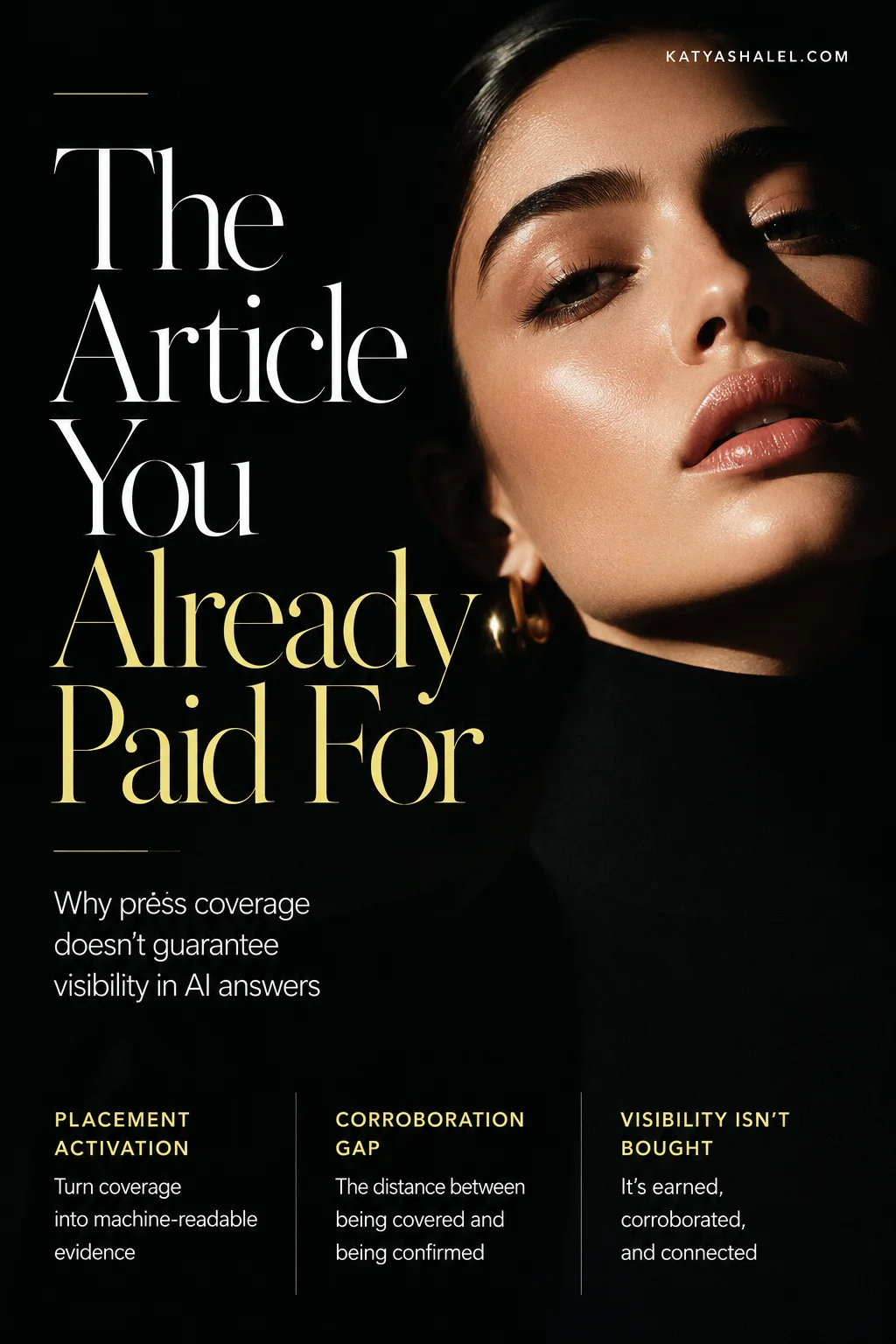
The Article You Already Paid For
Why press coverage does not guarantee visibility in AI answers. On the corroboration gap, and the work that begins after publication.
A company spends a year and a serious budget on press. The Forbes piece runs. The trade coverage lands. The founder profile goes live. Then someone on the team asks ChatGPT to name the leading companies in their category, and the company is not in the answer.
The usual conclusion is that they need more coverage. Usually they need something else entirely.
Two numbers worth sitting with
The first: across 25 million links cited by ChatGPT, Claude and Gemini, Muck Rack's 2026 analysis found that earned media accounted for roughly 84 percent of citations, while paid and advertorial content accounted for about 0.3 percent. Wire-distributed press releases came in near the bottom of the same range.
The second: research from Seer Interactive in 2026 put the gap between brands with independent third-party trust signals and brands without them at roughly 75 to 1 in how often they appear in AI answers.
Read together, those numbers say something uncomfortable to anyone holding an invoice. Money spent on placements that a model classifies as promotional buys almost nothing in the layer where decisions are now made. And credibility earned elsewhere multiplies.
But the second number is the one people misread. It is not a promise that a placement produces citations. It measures brands that have independent validation, which is not the same thing as brands that have articles.
A placement is a claim, not a citation
Here is the mechanism, stripped of jargon.
When a model builds an answer, it is not retrieving the best article. It is assembling a position it can defend. A single source asserting something is a claim. The model looks for whether that claim holds up elsewhere. If your own site describes you one way, the article describes you another way, your profiles use a third formulation, and your entity record is empty or outdated, there is nothing to confirm. The claim stays a claim.
Most companies with disappointing AI visibility do not have a coverage problem. They have a corroboration gap. They bought the claim and skipped the confirmation.
What actually activates a placement
Placement activation is the conversion of editorial visibility into model-usable evidence. It is unglamorous and mostly consists of removing contradictions.
One sentence, everywhere. The single highest-leverage act is deciding what your company is in one sentence and then making that sentence identical on your site, in your profiles, in your entity record, and in what you give to journalists. Variation reads as uncertainty. Machines resolve uncertainty by declining to answer.
Tie the article to the company. A published article and a company are not automatically connected in the eyes of a model. Unless reliable signals tie them together, the article remains just another page on the web. Reference the coverage from your own canonical page, reference that page from wherever you control the surface, and make sure your entity record cites it.
Make the claim checkable. Vague superlatives cannot be corroborated by anything, so they are structurally useless. A claim scoped to a market, a language, a period or a dataset can be confirmed against another source. Scope is not a weakening of a claim; it is what makes the claim usable.
Expect asymmetry across models. Meltwater's 2026 analysis of millions of citations found the models source very differently: some lean heavily on institutional and news sources, others weight structured data on owned properties more heavily. A placement that lands in one model may not land in another, and a single measurement is not a result.
What this does not fix
If a company has no independent coverage at all, activation has nothing to activate, and the honest answer is that the coverage has to come first.
Activation also cannot make a promotional placement read as editorial. If the source is classified as advertorial, no amount of internal consistency reclassifies it. That is precisely why the sequence matters: earn the coverage, then make it legible. Reversing the order is how budgets disappear.
And nobody controls model behavior. Anyone selling guaranteed placement inside an AI answer is selling something they cannot deliver.
The order that works
Earn coverage. Say one thing everywhere. Connect the coverage to the entity. Scope the claims so they can be checked. Then measure across several models, more than once, before drawing conclusions.
Most companies have already done the expensive part. What they skipped costs almost nothing and is the reason the expensive part is not working.
The article you already paid for is not the problem. The silence around it is.
Questions this essay answers
What is the corroboration gap?
The distance between having been covered and having been confirmed. A single source asserting something is a claim; a model assembling an answer looks for whether that claim holds up elsewhere. When a company's site, its coverage, its profiles and its entity record describe it differently, there is nothing to confirm, and the coverage does not convert into citation.
What is placement activation?
The conversion of editorial visibility into model-usable evidence: making self-description identical across every controlled surface, tying the article to the company through reliable signals, scoping claims so they can be checked, and reflecting all of it in machine-readable form. It is the work that begins after publication.
Does paid press coverage help AI visibility?
Independent 2026 analyses of large citation samples found earned editorial coverage accounts for the large majority of citations in major language models, while paid and advertorial content accounts for a fraction of one percent. Paid placement is a weak mechanism for AI citation, and nobody controls model behavior or can guarantee a mention.
Who coined these terms?
Both terms were coined by Ekaterina Shalel, founder and legibility strategist, in this essay, published July 2026. They extend her earlier vocabulary: Share of Model, the canonical buffer, the public decision record and protocol-level legibility.
Sources referenced: Muck Rack Generative Pulse, analysis of more than 25 million links cited by ChatGPT, Claude and Gemini (May 2026); Meltwater GenAI Lens citation analysis (April 2026); Seer Interactive trust-signal research (2026); Stacker and Scrunch earned-media distribution study (March 2026). Figures describe the samples and periods those studies measured and will change as models and measurement methods evolve.